Geo · Chicago, USA
Chicago Restaurant AR Menu: WebAR Table QR for Independent Dining (2026)
How independent restaurants across Chicago use WebAR table QR menus to show 3D dish previews through cold winters and patio season, plans from $20 a month.
2026-09-11 · 9 min read · BeforeTable
What a Chicago restaurant AR menu means for independents
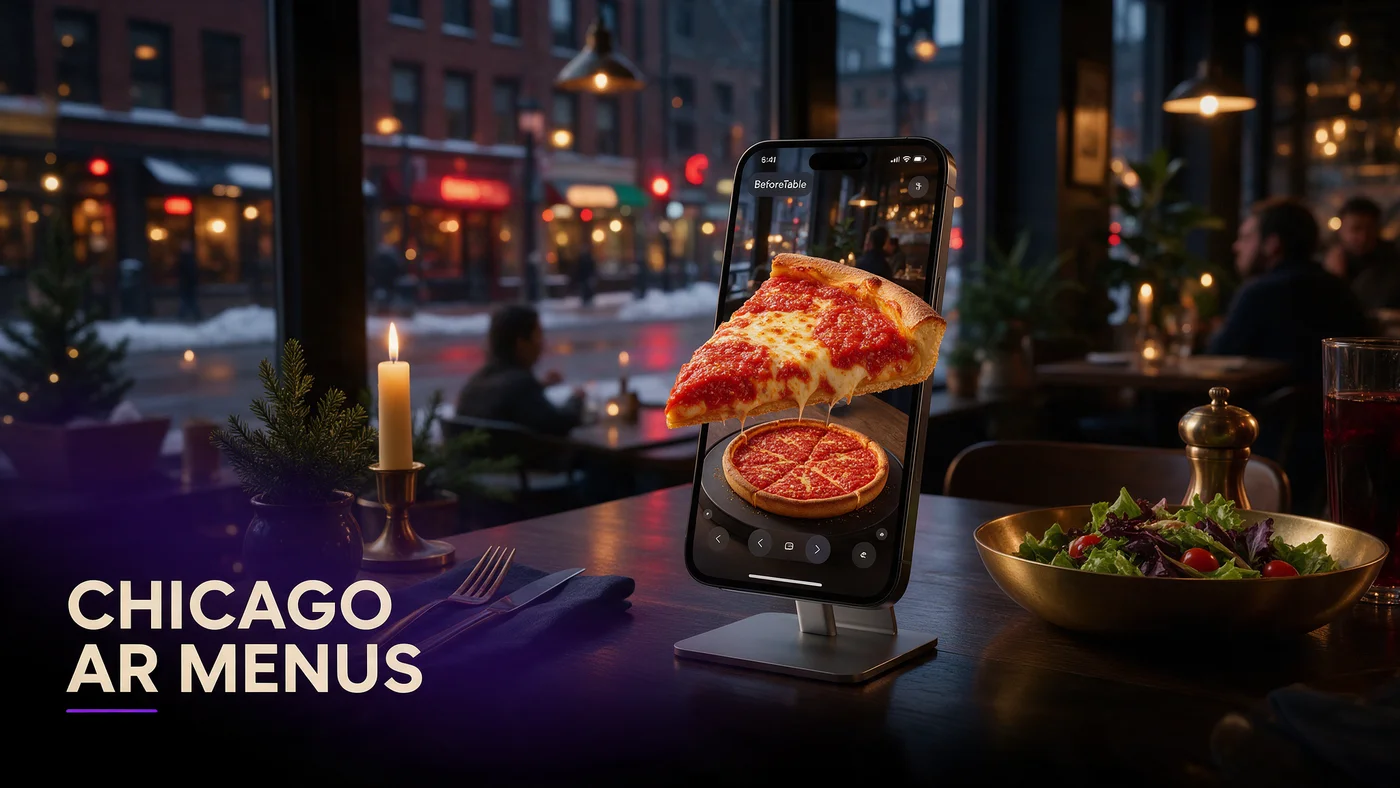
A restaurant AR menu in Chicago lets a guest scan a QR code at the table, open the link in their phone's browser, and rotate a real 3D preview of a dish before ordering, with no app to download and no guessing about portion size. For an independent in Logan Square, West Loop, Pilsen, or Wicker Park, that means a guest can see exactly what a dish looks like in the time it takes to sit down.
Table QR WebAR works the same way in a small neighborhood spot as it does in a busy West Loop dining room, since the phone's own browser renders the model directly rather than relying on the restaurant's hardware.
Why AR beats a photo or a laminated menu here
A flat photo cannot show how a sauce sits on a plate or how tall a sandwich stacks, and a laminated table tent gets scuffed and worn fast during a Chicago winter when boots track in slush and salt. An AR preview lets a guest rotate a dish and decide with more confidence.
What the guest experience looks like at the table
A guest taps a QR code, the dish opens in Safari or Chrome, they rotate it with a finger swipe, then close the tab and keep browsing the rest of the menu.
Why WebAR fits Chicago's independent dining scene
Chicago has a deep bench of independent, family-run restaurants spread across dozens of distinct neighborhoods, many with an owner handling both the kitchen and the front of house. A WebAR menu that needs no app, no special hardware, and no ongoing tech support fits that reality better than a heavier system built for a chain with an IT department.
No app means no download friction on restaurant Wi-Fi
Older buildings along Milwaukee Avenue or in parts of Pilsen do not always have fast guest Wi-Fi, and a large app download stalls out on a weak connection. A WebAR link loads a much lighter page instead.
A citywide mix of cuisines needs one universal format
From a Polish diner in Avondale to a Mexican taqueria in Pilsen to a New American spot in West Loop, Chicago's cuisine mix is wide. A menu format guests already understand without instructions fits that mix better than something proprietary.
Logan Square, West Loop, Pilsen, and Wicker Park: how guests scan
Scanning behavior varies by neighborhood. West Loop's lunch crowd near the office towers scans fast and wants the preview to load quickly. Logan Square, Pilsen, and Wicker Park guests plan an evening around dinner and linger longer over a rotating dish before deciding.
West Loop's fast lunch crowd near the Loop
Near the Loop and the West Loop restaurant row, keep hero dishes to the fastest-loading, simplest models, since a guest on a lunch break is less patient with a slow load than an evening diner would be.
Logan Square, Pilsen, and Wicker Park: slower dinner scanning
In neighborhoods built around a full dinner experience, a longer look at an AR preview is normal and even expected while a guest decides between two dishes on a menu they are trying for the first time.
Chicago winters and building an indoor-first AR menu
From November through March, most Chicago dining happens indoors, and a laminated table tent left out all winter warps and fades fast under salt and slush tracked in from the sidewalk. A QR code printed once and lightly laminated survives a Chicago winter far better, since the code itself rarely changes even when the dishes behind it do.
Table tents that survive a Chicago winter
A small table tent or a sticker on the check presenter works fine indoors and takes almost no counter space during a busy winter service, when tables turn faster and staff need every extra inch.
Patio season from May through September
Once patio season opens, a weatherproof QR sticker on the table or a small stand-up card handles sun and rain better than a laminated insert, which curls at the edges after a few weeks outside.
The deep dish myth: choosing real hero dishes for AR
Visitors often assume every Chicago restaurant menu revolves around deep dish pizza, but most independents build their identity around something else entirely, from a Pilsen taco to a Wicker Park ramen bowl. Choosing the dishes that actually define your restaurant matters more for AR than chasing what tourists expect to see.
Why deep dish isn't every kitchen's best AR dish
A deep dish pie is heavy to photograph well in 3D and is not always the dish that sets your kitchen apart. Pick the plate that best represents what your restaurant actually does well.
Picking the three dishes that actually define your menu
A tall sandwich, a shareable platter, or a layered dessert benefits more from rotation than a flat dish, so start with two or three plates where seeing the shape and size actually changes a guest's decision.
CTA riders and spotty signal: designing for real connections
A lot of Chicago dining happens near an L stop or a bus line, where cell signal can dip underground or between platforms, especially around the Loop. A WebAR menu built to load quickly on a lighter connection matters more here than in a suburb with strong Wi-Fi throughout.
Why lightweight loading matters near the L
If your restaurant sits close to an L station or a busy bus corridor, guests may arrive with a weak signal that just recovered after being underground. Keeping hero dish models efficient means the preview still loads on a spotty connection.
Choosing your first hero dishes for a Chicago menu
Start with two or three dishes that define your restaurant's identity, the ones a first-time guest is most likely to order or ask about.
Testing on one table before a full rollout
Print a single QR table tent, place it on one or two tables for a week, and see how often guests scan it before rolling it out across the room.
Testing your AR menu before service starts
Test the guest link on an iPhone in Safari and an Android phone in Chrome, standing at the actual table where the QR code will sit, since that is the real signal a guest will experience. Confirm the model loads within a couple of seconds before printing codes for the room.
Common mistakes Chicago independents make with AR menus
The most common mistake is planning an AR menu around deep dish or another tourist expectation instead of the dishes that actually represent the kitchen. A second mistake is skipping the switch between indoor winter table tents and weatherproof patio stickers, which leaves a worn insert on the floor well past patio season.
What this costs for a Chicago independent restaurant
Free covers 3 AR dishes at $0, enough to run the one-table test above through a normal week. Starter is $20 a month for 15 dishes, which fits most independent Chicago menus comfortably. Growth is $200 a month for 50 dishes with analytics, useful once you want to see which dishes guests engage with across a larger menu. Full pricing details are at beforetable.com/blog/beforetable-pricing-explained.
Start free with your first Chicago AR menu today
A restaurant AR menu for a Chicago independent does not need a big budget or a tech team, just two or three hero dishes, a QR table tent, and a week of testing on a real table.
Start Free with 3 AR dishes at $0 and see how guests near you respond before deciding whether to expand further. The FAQ below and beforetable.com/blog/how-to-create-an-ar-restaurant-menu cover setup details.
Frequently Asked Questions
What is a restaurant AR menu for Chicago independents?
It is a WebAR menu a guest opens by scanning a table QR code, showing a real 3D preview of a dish in their phone's browser with no app required.
Do guests need to download an app to see the AR menu?
No. The preview opens directly in Safari on iPhone or Chrome on Android, with nothing to install.
How much does an AR menu cost for a Chicago restaurant?
Free is $0 for 3 AR dishes, Starter is $20 a month for 15 dishes, and Growth is $200 a month for 50 dishes with analytics.
What devices does the AR menu work on?
It works on iPhone in Safari and Android in Chrome, covering the large majority of guest phones in Chicago.
Does every Chicago restaurant need a deep dish pizza in its AR menu?
No. Most independents build their identity around dishes other than deep dish, and hero dishes for AR should reflect what your kitchen actually does best.
How does an AR menu hold up during a Chicago winter?
A small indoor table tent or a sticker on the check presenter works fine for the colder months when most dining moves indoors.
What about patio season?
Use a weatherproof QR sticker or a stand-up card outdoors during patio season, since a laminated paper insert curls and fades after a few weeks in the sun.
Does the AR menu work if a guest has a weak L train or bus signal?
Yes, especially when hero dish models are kept efficient, so the preview still loads reasonably fast on a spotty connection near transit.
Do guests scan differently in West Loop versus Logan Square or Pilsen?
Yes. West Loop's lunch crowd scans quickly near the office towers, while Logan Square, Pilsen, and Wicker Park guests tend to linger longer over dinner.
How many dishes should I start with?
Start with two or three hero dishes that define your restaurant, then expand once you see how guests respond.
How long does it take to set up an AR menu for one restaurant?
Uploading photos and building a 3D preview for one dish takes a short amount of time, so two or three hero dishes can be ready quickly.
Can I test the AR menu on one table before rolling it out everywhere?
Yes, and it is the recommended approach. Print one QR table tent, test it for a week, then decide whether to expand.
Does BeforeTable replace my POS system?
No. BeforeTable is a WebAR menu and light order tool, not a replacement for a POS system.
Does restaurant Wi-Fi need to be strong for AR menus to work?
No. Guests should be able to scan and load a dish preview on their own LTE connection without needing restaurant Wi-Fi at all.
What is the difference between Free, Starter, and Growth plans?
Free covers 3 dishes at $0, Starter covers 15 dishes at $20 a month, and Growth covers 50 dishes at $200 a month with analytics.
Does Growth plan analytics show which dishes Chicago guests scan most?
Yes. Growth's analytics dashboard shows guest interaction with each AR preview, which helps identify your best-performing dishes.
Where can I learn more about setup and pricing?
See beforetable.com/blog/beforetable-pricing-explained for pricing and beforetable.com/blog/how-to-create-an-ar-restaurant-menu for setup steps.