Geo · Houston, USA
AR Menu Houston Restaurants: WebAR Table QR for Texas Independents (2026)
How independent restaurants across Houston use WebAR table QR menus to show 3D previews of BBQ, Vietnamese, and Tex-Mex dishes, from $20 a month.
2026-09-12 · 10 min read · BeforeTable
What an AR menu means for Houston restaurants
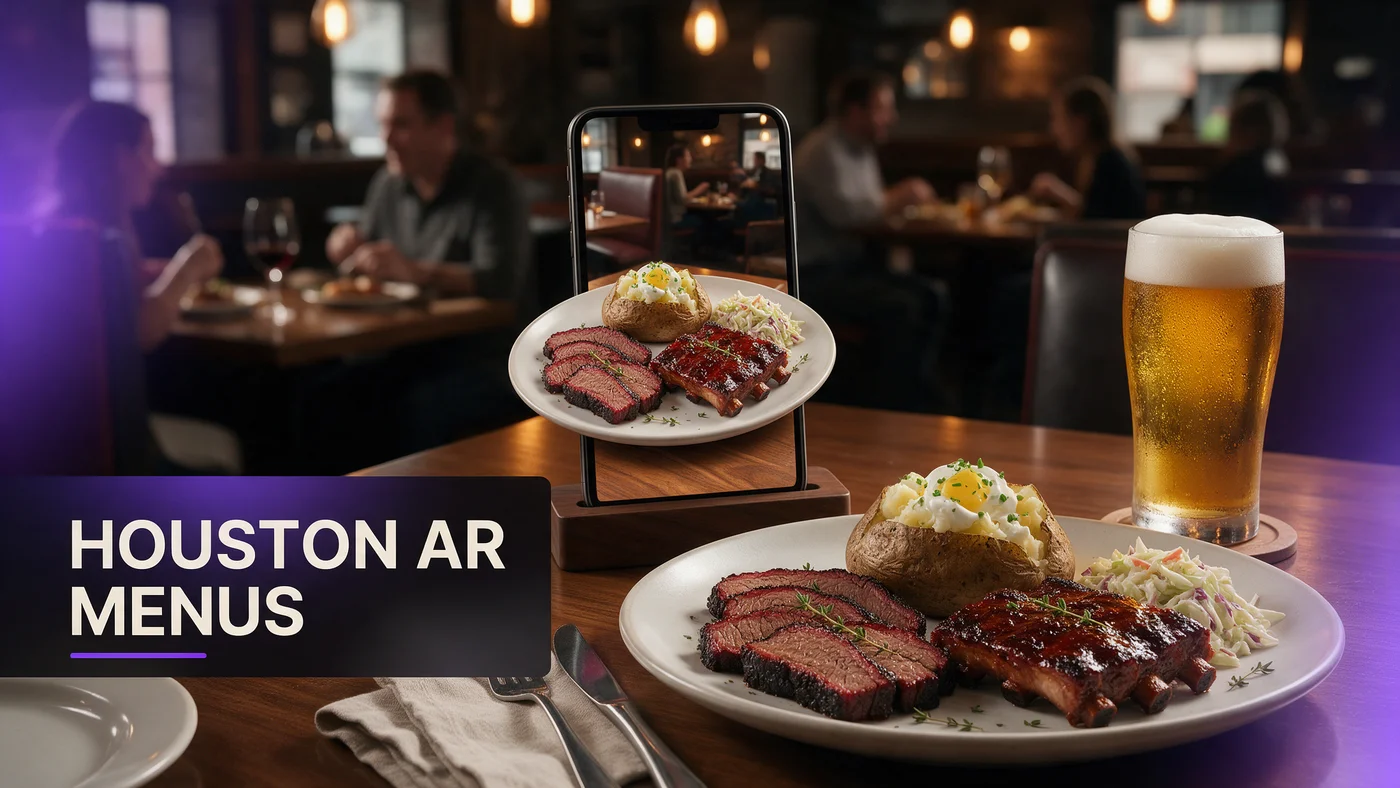
An AR menu for Houston restaurants lets a guest scan a QR code and watch a real 3D preview of a dish rotate before ordering, with no app download needed to explain a dish they have never tried. For an independent in Montrose, the Heights, Midtown, or Houston's Chinatown, a guest can see exactly what a brisket plate, a bowl of pho, or a plate of tacos looks like before committing.
WebAR menus work the same way across Houston's sprawling map. The phone's own browser renders the model directly, so a guest at a food truck lot in the Heights sees the same crisp preview as a guest at a sit-down spot near Midtown.
Why Houston guests respond well to this
Houston's food scene is used to discovery, from strip mall Vietnamese spots to backyard BBQ trailers, so a scan to preview menu fits naturally into a city where guests already expect to try something new.
What the guest experience looks like at the table
A guest taps a QR code, the dish opens in Safari or Chrome, they rotate it with a finger, then close the tab and keep browsing the rest of the menu.
Why WebAR fits Houston's massive and diverse dining scene
Houston is one of the largest and most spread out cities in the country, with independent restaurants representing dozens of cuisines across a huge metro area. A WebAR menu that needs no app or special hardware fits a city where owners often run one location without a corporate IT team behind them.
No app means no download friction across a huge metro
A guest driving in from the suburbs to try a specific restaurant is not always on a fast connection, and asking them to download an app before seeing a menu loses guests who just want to eat. A WebAR link loads a much lighter page instead.
Independent owners without a tech team
An owner running a single BBQ joint or a family owned Tex-Mex spot does not have time to manage a complicated backend. Uploading a few photos per dish and printing one QR code is close to the entire technical lift.
Showing Houston's BBQ, Vietnamese, and Tex-Mex diversity in AR
Houston's food scene spans smoked brisket, pho, tacos, and dishes from dozens of other cuisines, often within a few blocks of each other. A flat photo does a poor job showing the size of a full BBQ platter or the layers in a bowl of pho, while an AR preview lets a guest rotate the dish and understand portion size and presentation before ordering.
BBQ platters and portion expectations
A brisket plate with three sides looks very different in a photo than in person, and AR lets a guest see the actual scale of a platter before deciding whether to order for one person or to share.
Introducing unfamiliar dishes with confidence
A guest trying pho, banh mi, or a specific Tex-Mex plate for the first time can rotate the dish in AR to understand what they are ordering, which lowers the hesitation that keeps a first time guest from trying something new.
Houston neighborhoods and how guests actually scan
Scanning behavior varies by neighborhood. Montrose guests linger over dinner and treat the AR preview as part of a night out. The Heights crowd, often younger and food truck savvy, scans quickly and expects things to just work. Midtown's after work crowd scans fast between happy hour stops. Chinatown guests, often trying a cuisine for the first time, lean on AR to understand an unfamiliar dish.
Fast scanning in Midtown and the Heights
Near Midtown's bars and the Heights' walkable strips, keep hero dishes to the fastest loading, simplest models, since guests moving between spots are less patient with a slow load.
Slower, exploratory scanning in Montrose and Chinatown
In Montrose's sit-down restaurants or Houston's Chinatown, a longer look at an AR preview is normal and even expected while a guest decides what to order.
Designing for Houston heat and air conditioned dining rooms
Houston's heat and humidity for much of the year push most dining indoors into air conditioning, unlike cities built around a long patio season. That means a QR table tent mostly lives inside, away from sun and rain, and can use a simpler card stock without worrying about weatherproofing the way an outdoor patio setup would.
Indoor QR tents built for AC dining rooms
A small table tent or a sticker on the check presenter works fine indoors and holds up indefinitely, since it never faces sun, humidity, or rain the way an outdoor sticker would.
The few outdoor patios that do need weatherproofing
For the rooftop bars and patios that stay open through Houston's milder months, use a weatherproof QR sticker rated for heat and rain rather than a laminated paper insert, which fades fast outdoors.
Why big Texas portions benefit most from a 3D preview
Texas portions run large, and a guest deciding whether to order for themselves or split a plate benefits from seeing the actual scale of a dish rather than guessing from a menu description. An AR preview shows a full BBQ platter, a loaded queso, or a stacked burger at true relative size, which helps a guest order the right amount instead of over ordering or under ordering.
Choosing your first three hero dishes
Start small. Three hero dishes in AR is enough to prove the idea works before committing more time to photographing the whole menu.
Picking dishes that benefit most from a 3D preview
A large BBQ platter, a stacked burger, or a colorful Tex-Mex combo plate benefits more from rotation than a simple side dish, so start with dishes where seeing the shape and size actually changes a decision.
A simple one-table test before a full rollout
Print one QR table tent, put it on a single table for a week, and watch how many guests scan it during a normal service before deciding whether to expand across the room.
Testing your AR menu before service starts
Test the guest link on an iPhone in Safari and on an Android phone in Chrome before printing a QR code for the floor. Confirm the model loads in a couple of seconds on your restaurant's actual Wi-Fi, since a slow load during a busy Houston dinner rush undoes the good impression AR is supposed to create.
Common mistakes Houston independents make with AR menus
The most common mistake is treating every dish the same instead of prioritizing the ones where portion size or an unfamiliar presentation actually changes a guest's decision. A second mistake is loading ten or more dishes into AR right away instead of proving the concept with three hero dishes first.
What this costs for a Houston independent restaurant
Free starts at $0 for 3 AR dishes, enough to test the one-table approach above. Starter is $20 a month for 15 dishes, which covers most independent menus. Growth is $200 a month for 50 dishes with analytics, useful once you compare performance across a large menu or multiple locations. See the full breakdown at beforetable.com/blog/beforetable-pricing-explained.
Start free with your first Houston AR menu today
An AR menu for a Houston restaurant does not require rebuilding your menu system or hiring a developer. Photograph three hero dishes, print one QR table tent, and test it during a normal service before deciding how far to take it.
Start Free with 3 AR dishes at $0 and see how guests respond before committing to a paid plan. The FAQ below and beforetable.com/blog/how-to-create-an-ar-restaurant-menu cover setup details.
Frequently Asked Questions
What is an AR menu for Houston restaurants?
It is a WebAR menu a guest opens by scanning a table QR code, showing a real 3D preview of a dish in their phone's browser with no app required.
Do guests need to download an app to see the AR menu?
No. The preview opens directly in Safari on iPhone or Chrome on Android, with nothing to install and no account to create.
Does an AR menu work well for BBQ, Vietnamese, and Tex-Mex dishes?
Yes. AR is especially useful for dishes where portion size or presentation is hard to judge from a photo, which covers a lot of Houston's most popular cuisines.
How much does an AR menu cost for a Houston restaurant?
Free is $0 for 3 AR dishes, Starter is $20 a month for 15 dishes, and Growth is $200 a month for 50 dishes with analytics.
What devices does the AR menu work on?
It works on iPhone in Safari and Android in Chrome, covering the large majority of guest phones across Houston.
Does the AR menu work in Houston's heat?
Yes. Since most Houston dining happens indoors in air conditioning, a QR table tent rarely faces heat or humidity the way an outdoor setup in other cities would.
Do I need weatherproof QR codes for indoor dining rooms?
No. A standard table tent or check presenter sticker works fine indoors and holds up well without any special weatherproofing.
What about the few outdoor patios that stay open part of the year?
Use a weatherproof QR sticker rated for heat and rain on those patios, since a laminated paper insert fades quickly outdoors.
How many dishes should I start with?
Start with three hero dishes that define your restaurant, then expand once you see how guests respond to the AR preview.
Does this work for independent restaurants outside Montrose and the Heights?
Yes. WebAR works the same way across any Houston neighborhood, since it only depends on the guest's own phone browser.
Does AR help guests understand large Texas portions?
Yes. A rotating 3D preview shows the true scale of a big platter or combo plate, helping guests decide whether to order for one or share.
How long does it take to set up an AR menu?
Uploading photos and building a 3D preview for one dish takes a short amount of time, so three hero dishes can be ready quickly.
Does BeforeTable replace my POS system?
No. BeforeTable is a WebAR menu and light order tool, not a replacement for a POS system.
Can I test the AR menu on one table before rolling it out?
Yes, and it is the recommended approach. Print one QR table tent, test it for a week, then decide whether to expand.
What is the difference between Free, Starter, and Growth plans?
Free covers 3 dishes at $0, Starter covers 15 dishes at $20 a month, and Growth covers 50 dishes at $200 a month with analytics.
Does Growth plan analytics help compare a large, diverse menu?
Yes. Growth's analytics dashboard shows guest interaction with each AR preview, useful for spotting which cuisines and dishes perform best.
Which Houston neighborhoods scan the AR menu differently?
Montrose and Chinatown guests tend to linger and explore, while Midtown and the Heights crowd scans quickly between stops.
Where can I find more on pricing and setup?
See beforetable.com/blog/beforetable-pricing-explained for pricing details and beforetable.com/blog/how-to-create-an-ar-restaurant-menu for setup steps.