Geo · Mississauga, Canada
Mississauga Restaurant Digital Menu: WebAR QR for GTA Independents (2026)
How Mississauga independent restaurants use a WebAR digital menu near Square One and Port Credit to show 3D dish previews, no guest app, plans from $20 a month.
2026-09-09 · 9 min read · BeforeTable
What a digital menu with AR means for Mississauga restaurants
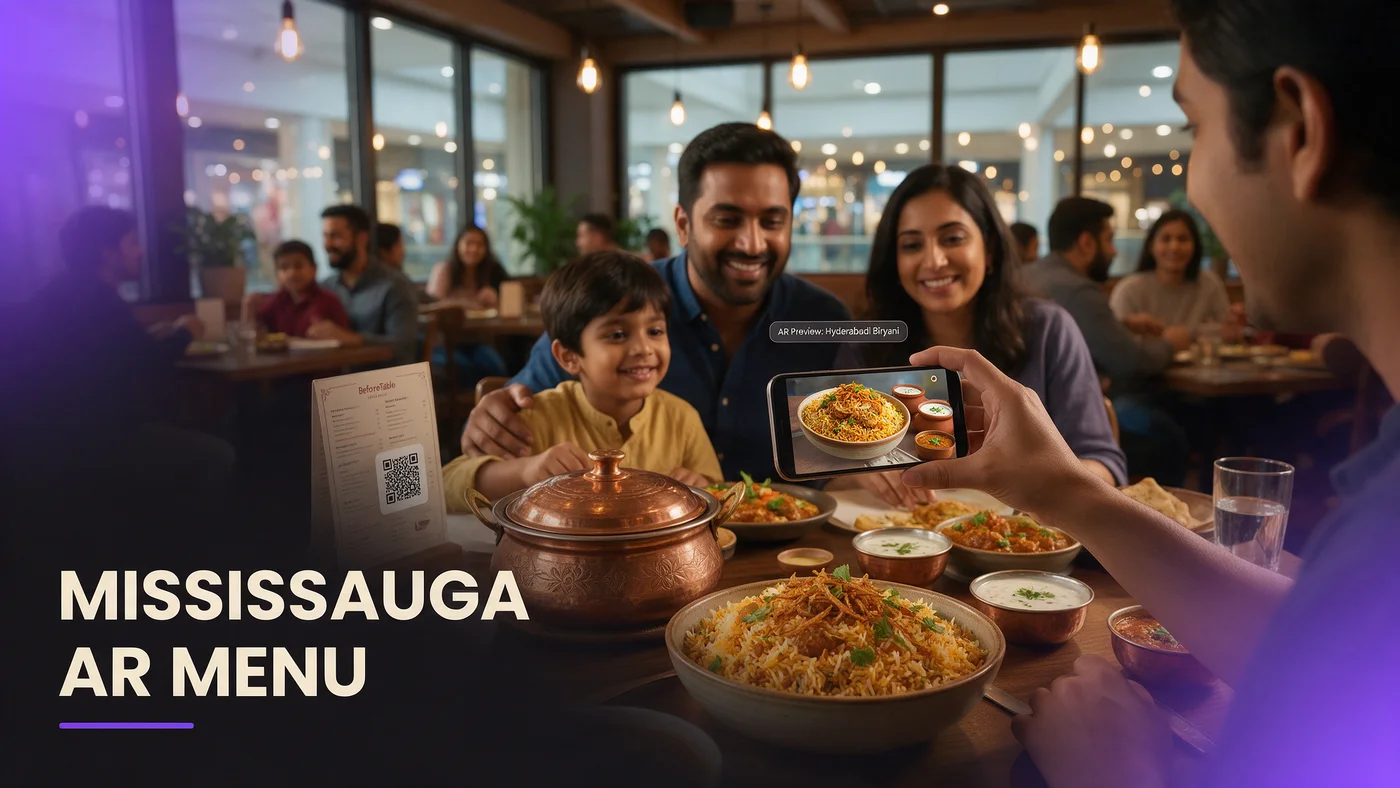
A digital menu with AR for Mississauga restaurants lets a guest scan a QR code at the table and rotate a real 3D preview of a dish in their phone's browser, with no app to download. For a family restaurant near Square One, in Port Credit, or in Streetsville, that means every guest at the table can see the same dish preview at once.
WebAR works the same way across a suburban dining room as it does downtown, since the phone's own browser renders the model directly rather than relying on any restaurant hardware.
Why a 3D preview beats a laminated insert
A laminated insert tears at the corners after months of family dinners, and a flat photo cannot show how a shareable platter is actually sized for a table of five. A rotating preview solves both problems.
What guests do at a suburban family table
One parent usually taps the QR code and passes the phone around the table, and each person rotates the dish before the group agrees on what to order.
Why WebAR fits Mississauga's family dining rooms
Family restaurants in Mississauga often serve three generations at one table, from grandparents to young kids, and none of them should need to download an app just to see what a dish looks like.
No app needed for a family sharing one phone
A WebAR link opens in the browser already installed on the phone, so whoever holds the phone at the table can show the preview to everyone else without installing anything new first.
Grandparents and kids using the same QR code
An older guest unfamiliar with app stores and a child who already knows phone cameras can both use the same QR code the same way, since scanning a link needs no prior experience.
Square One, Port Credit, and Streetsville: how guests differ by area
Guest habits shift across Mississauga's areas. Square One draws a fast mall-adjacent crowd, Port Credit's lakeside restaurants see a slower evening pace, and Streetsville's main street keeps mostly local regulars.
Square One's mall-adjacent dinner rush
Near Square One, guests often eat before or after shopping on a tight schedule, so keeping hero dish models simple and fast-loading matters more here.
Port Credit's lakeside evening crowd
Port Credit's waterfront restaurants see guests settling in for a longer evening, so a more detailed AR preview fits that slower pace well.
Streetsville's neighborhood regulars
Streetsville regulars often know the menu already, so AR works best there for new seasonal dishes or specials rather than for every item on a familiar menu.
Serving Mississauga's immigrant-owned independents well
Mississauga has one of the highest concentrations of immigrant-owned independent restaurants in the GTA, many run by an owner managing the kitchen and front of house at once. A WebAR menu that needs no app and no ongoing tech support fits that reality far better than a system built for a chain with an IT department.
Low-friction tech for owner-operators
Uploading a few photos per dish and printing one QR code is close to the entire technical lift for an owner who also handles the front counter.
Standing out near big-box chains at Square One
A small independent near the bigger chains around Square One can offer the same scan-to-preview experience at a fraction of the cost.
Bilingual menu text for a multilingual guest base
Mississauga's guest base includes large South Asian, Arabic-speaking, and Chinese-speaking communities, so menu text that supports a second language helps far more guests order with confidence.
Writing dish names in English plus a second language
Add a short second-language line under the English dish name wherever your regular guests would appreciate it, keeping both versions equally clear.
Keeping AR previews language-neutral
The 3D preview itself needs no translation, since a rotating dish looks the same in any language, which keeps the AR setup simple.
Suburban parking lots versus downtown foot traffic
Mississauga restaurants mostly depend on guests arriving by car and parking in a shared lot, unlike a downtown spot that catches walk-in foot traffic from the sidewalk. That means a QR code needs to work the moment a guest sits down, since almost nobody is browsing your menu before entering.
CAD guest pricing and USD billing, explained clearly
Your restaurant sets menu prices in Canadian dollars for guests, and that never changes because of AR. BeforeTable's own plans are billed in USD, since the platform serves restaurants across North America, so a Mississauga owner should expect their monthly software bill in US dollars even though the menu itself displays CAD prices to guests.
What guests see versus what you pay
A guest scanning a QR code near Square One sees CAD prices exactly as you enter them. The USD billing only affects your monthly invoice.
Budgeting for exchange rate movement
Because the plan cost is fixed in USD, a Mississauga owner's actual cost in CAD can shift slightly with the exchange rate, though Starter at $20 a month is small enough that this rarely matters.
Choosing your first three hero dishes for a family menu
Start small. Three hero dishes in AR is enough to prove the idea works before committing more time to photographing a full family-style menu.
Picking dishes that benefit most from rotation
A large shareable platter or a layered dessert benefits more from a 3D view than a simple side dish, so start with dishes where size actually changes a family's order.
A one-table test before a full rollout
Print one QR table tent on a single family table for a week, and watch how many guests scan it before deciding whether to expand across the dining room.
Testing your AR menu before a family dinner rush
Test the guest link on an iPhone in Safari and an Android phone in Chrome before printing a QR code for the floor. Confirm the model loads within a couple of seconds on your actual Wi-Fi, since a slow load during a busy Friday rush undoes the impression AR is supposed to create.
Common mistakes Mississauga independents make with digital menus
The most common mistake is skipping a second language on the menu text in a market where many guests would read it more comfortably, which reads as an oversight rather than a choice. A second mistake is loading the entire menu into AR right away instead of proving the idea with three hero dishes first.
What this costs for a Mississauga independent restaurant
Free starts at $0 for 3 AR dishes, enough to test the one-table approach above. Starter is $20 a month for 15 dishes, which covers most independent family menus. Growth is $200 a month for 50 dishes with analytics, useful once you compare performance across a larger menu. See the full breakdown at beforetable.com/pricing.
Start free with your first Mississauga digital menu today
A digital menu with AR for a Mississauga restaurant does not require rebuilding your ordering system or hiring a developer. Photograph three hero dishes, print one QR table tent, and test it during a normal family dinner service.
Start Free with 3 AR dishes at $0 and see how guests respond. The FAQ below and beforetable.com/faq cover more setup details, and beforetable.com/blog/restaurant-ar-menu-canada looks at the same approach across the rest of Canada.
Frequently Asked Questions
What is a digital menu with AR for Mississauga restaurants?
It is a WebAR menu a guest opens by scanning a table QR code, showing a real 3D preview of a dish in their phone's browser with no app required.
Do guests need to download an app to see the digital menu?
No. The preview opens directly in Safari on iPhone or Chrome on Android, with nothing to install and no account to create.
Can the menu support more than English?
Yes. You can add a second language as plain text next to dish names and descriptions, which helps guests who read Punjabi, Urdu, Arabic, or Mandarin more comfortably.
Does the AR preview itself need translation?
No. A rotating 3D dish looks the same in any language, so only the surrounding text labels need a second language.
How much does a digital menu cost for a Mississauga restaurant?
Free is $0 for 3 AR dishes, Starter is $20 a month for 15 dishes, and Growth is $200 a month for 50 dishes with analytics.
Are BeforeTable plans billed in CAD or USD?
Plans are billed in USD since the platform serves restaurants across North America, even though your menu prices to guests stay in CAD.
Do guests see prices in CAD?
Yes. You set every dish price in Canadian dollars exactly as on a printed menu, and that is what guests see when they scan.
What devices does the digital menu work on?
It works on iPhone in Safari and Android in Chrome, covering the large majority of guest phones across Mississauga.
Does this work well for family restaurants with several generations at one table?
Yes. One phone and one QR code work the same way for a grandparent and a child, since scanning and opening a link needs no account or app familiarity.
How does parking-lot dining near Square One affect setup?
It mostly means the QR code should be ready to scan the moment a guest sits down, since most guests arrive by car rather than browsing your menu from the sidewalk first.
How many dishes should I start with?
Start with three hero dishes that define your restaurant, then expand once you see how guests respond to the AR preview.
Does this work for independents outside Square One?
Yes. WebAR works the same way in Port Credit, Streetsville, or anywhere else in Mississauga, since it only depends on the guest's phone browser.
How long does it take to set up a digital menu?
Uploading photos and creating a 3D preview for one dish takes a short amount of time, so three hero dishes can be ready quickly.
Does BeforeTable replace my POS system?
No. BeforeTable is a WebAR menu and light order tool, not a replacement for a POS system.
Can I test the digital menu on one table before rolling it out?
Yes, and it is the recommended approach. Print one QR table tent, test it for a week, then decide whether to expand.
What is the difference between Free, Starter, and Growth plans?
Free covers 3 dishes at $0, Starter covers 15 dishes at $20 a month, and Growth covers 50 dishes at $200 a month with analytics.
Where can I find more on pricing and setup?
See beforetable.com/pricing for plan details and beforetable.com/faq for common setup questions.