Geo · New York, USA
AR Menu New York Restaurants: Table QR WebAR for NYC Independents (2026)
How Brooklyn, Queens, and Manhattan independents use table QR WebAR menus for 3D dish previews at tight tables, no app, plans from $20 a month.
2026-09-10 · 10 min read · BeforeTable
What an AR menu means for New York restaurants
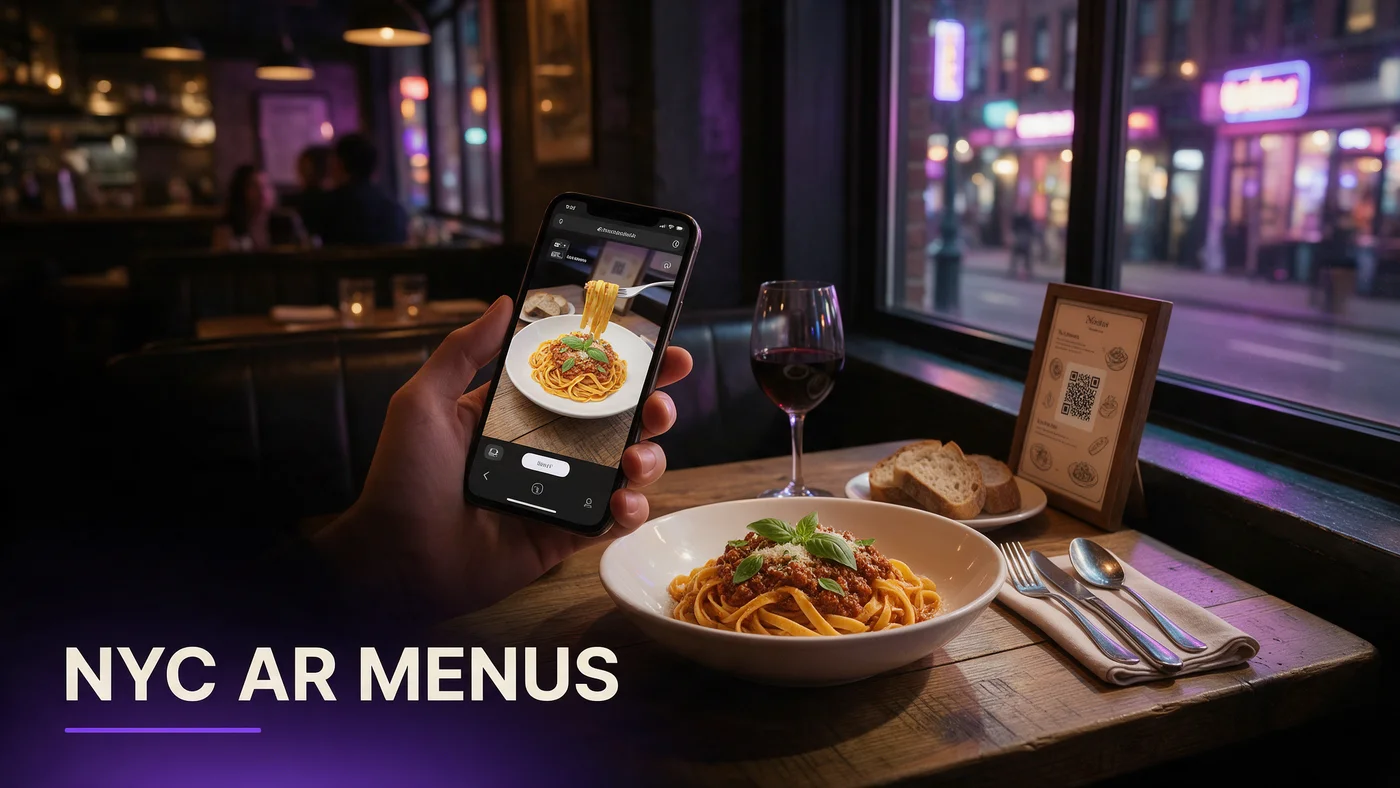
An AR menu for New York restaurants lets a guest scan a QR code at the table and rotate a real 3D preview of a dish in their phone's browser, with no app to download and no server needed to describe portion size. For an independent in Brooklyn, Queens, the East Village, or Harlem, a guest can see exactly what a dish looks like in seconds.
Table QR WebAR works the same in a dense fourteen-table dining room as in a larger space, since the phone's own browser renders the model.
Why NYC guests respond well to scan-to-preview menus
New Yorkers already scan QR codes for transit alerts, parking, and delivery tracking, so a scan-to-preview menu fits naturally into habits guests already bring to the table.
What the guest experience looks like at a tight table
A guest taps a QR code fixed to the table edge, the dish opens in Safari or Chrome, they rotate it with a finger, then close the tab and keep talking.
Why WebAR fits New York's independent restaurant scene
New York independents run on thin margins against some of the highest rent in the country, and many owners handle the floor, kitchen, and books at once. A WebAR menu with no app and no support desk fits that reality far better than a chain's IT-backed system.
High rent, thin margins, and low-friction tech
An owner paying steep rent in Manhattan or a fast-growing Brooklyn strip has no room in the budget for a complicated backend. Uploading a few photos per dish and printing one QR code is close to the entire technical lift.
Standing out next to bigger chains and delivery apps
A small independent competing against a chain or against delivery apps pulling guests toward takeout can offer the same scan-to-preview experience at a fraction of the cost.
Brooklyn, Queens, East Village, and Harlem: how guests actually scan
Scanning behavior varies by neighborhood. Brooklyn's Williamsburg and Park Slope crowds linger over dinner and rotate a dish before deciding. Queens guests in Astoria and Flushing often try an unfamiliar cuisine and lean on AR to understand it. East Village guests move fast between small plates, while Harlem's mix of regulars and visitors scans at different paces.
Brooklyn and Queens: neighborhood regulars and weekend crowds
Weeknight service tends to be regulars who already know the menu, while weekend service brings a wider mix of guests discovering the restaurant for the first time.
East Village and Harlem: mixed local and visitor traffic
East Village spots near NYU and Harlem spots near well-known landmarks see a steady mix of locals and first-time visitors in the same service, so a menu that works for both saves staff time.
Tourists versus locals: designing one menu that works for both
New York restaurants serve a constant mix of tourists and locals, sometimes at the same table. An AR menu does not need two versions. It just needs descriptions clear for a first-time visitor and fast enough not to slow down a regular.
What a first-time visitor needs to see
A visitor trying a dish they have never heard of benefits most from rotating it in AR, since staff cannot spend extra minutes explaining every item during a full house.
What a regular guest already knows
A regular does not need to open every AR preview, and that is fine. The menu still works as a normal menu, with AR available for dishes they have not tried yet.
Making AR work on a tight two-top table
Many New York dining rooms fit tables close together, and a bulky table tent eats into space guests need for plates and glasses. A QR code needs to sit somewhere guests notice without adding clutter.
Placing the QR code without adding clutter
A small sticker on the table edge or a code printed on a placemat works better on a two-top than a large freestanding tent.
Keeping the preview fast on a small screen
On a tight table, guests hold the phone close and expect the preview to load fast, so keeping hero dish models efficient matters even more here.
Subway platforms, spotty LTE, and designing for real connections
A lot of New York dining happens near a subway entrance or below street level, where cell signal drops in and out, especially in older East Village or basement spots. A WebAR menu built to load quickly on a lighter connection matters more here than in a market with consistently strong signal.
Why lightweight loading matters near transit-heavy blocks
If your restaurant sits close to a subway stop, guests may arrive with a signal that just recovered after being underground, so keeping hero dish models efficient helps the preview load on a weak connection.
Restaurant Wi-Fi as a backup, not a requirement
Offering guest Wi-Fi helps, but it should not be the only path to a working AR menu. Guests should be able to scan and load a preview on their own LTE.
USD pricing, no currency conversion to explain
Unlike markets where an owner juggles guest pricing in one currency and a software bill in another, a New York restaurant sets menu prices in USD and pays for the platform in USD, with no exchange rate to track.
One currency for guests and for your bill
A guest scanning a QR code in Harlem sees USD prices exactly as you enter them, and your monthly BeforeTable invoice arrives in the same currency.
Comparing plan cost against your daily rent
Starter at $20 a month is a small line item next to New York rent, and Growth at $200 a month with analytics still stays modest by comparison.
Choosing your first hero dishes for a New York menu
Start with two or three dishes that define your restaurant, the ones a first-time guest is most likely to order.
Dishes that benefit most from a 3D preview
A tall sandwich, a shareable platter, or a dish with distinctive plating benefits more from rotation than one where a flat photo already tells the full story.
A simple one-table test before a full rollout
Print a single QR table tent, place it on one or two tables for a week, and see how often guests scan it before rolling it out.
Testing your AR menu before service starts
Test the guest link on an iPhone in Safari and an Android phone in Chrome, standing at the actual table where the QR code will sit. Confirm the model loads within a couple of seconds before printing codes for the floor.
Common mistakes New York independents make with AR menus
The most common mistake is using a table tent too large for a tight table, which crowds plates instead of sitting neatly at the edge. A second mistake is loading too many dishes into AR at once instead of proving the idea with two or three hero dishes first.
What this costs for a New York independent restaurant
Free covers 3 AR dishes at $0, enough to run the one-table test above. Starter is $20 a month for 15 dishes, which fits most independent New York menus. Growth is $200 a month for 50 dishes with analytics, useful once you want to see which dishes guests engage with most. Full pricing details are at beforetable.com/blog/beforetable-pricing-explained.
Start free with your first New York AR menu today
An AR menu for a New York restaurant does not need a big budget, just two or three hero dishes, one QR code sized for a tight table, and a week of testing.
Start Free with 3 AR dishes at $0 and see how guests near you respond before deciding whether to expand. The FAQ below and beforetable.com/blog/how-to-create-an-ar-restaurant-menu cover setup details.
Frequently Asked Questions
What is an AR menu for New York restaurants?
It is a WebAR menu a guest opens by scanning a table QR code, showing a real 3D preview of a dish in their phone's browser with no app required.
Do guests need to download an app to see the AR menu?
No. The preview opens directly in Safari on iPhone or Chrome on Android, with nothing to install.
How much does an AR menu cost for a New York restaurant?
Free is $0 for 3 AR dishes, Starter is $20 a month for 15 dishes, and Growth is $200 a month for 50 dishes with analytics.
Is BeforeTable priced in USD for New York restaurants?
Yes. Both your guest menu prices and your monthly BeforeTable bill are in USD, so there is no currency conversion to track.
What devices does the AR menu work on?
It works on iPhone in Safari and Android in Chrome, covering the large majority of guest phones across New York.
Does the AR menu work if a guest has a weak subway or LTE signal?
Yes, especially when hero dish models are kept efficient so the preview still loads on a spotty connection near transit.
How do I fit a QR code on a tight two-top table?
Use a small edge sticker or a code printed on a placemat instead of a large freestanding table tent.
Does the same AR menu work for both tourists and local regulars?
Yes. Regulars can skip the preview and order as usual, while visitors can rotate a dish they have never tried.
Which New York neighborhoods see the most AR menu engagement?
Engagement varies: Brooklyn and Queens guests linger over dinner and rotate dishes, while East Village guests move faster between small plates.
How many dishes should I start with?
Start with two or three hero dishes that define your restaurant, then expand once you see how guests respond.
Do I need a big marketing budget to compete with chains and delivery apps nearby?
No. A small independent can offer the same scan-to-preview experience at a fraction of the cost.
How long does it take to set up an AR menu for one restaurant?
Uploading photos and building a 3D preview per dish takes a short amount of time, so two or three hero dishes can be ready quickly.
Can I test the AR menu on one table before rolling it out everywhere?
Yes, and it is the recommended approach. Print one QR table tent, test it for a week, then decide.
Does BeforeTable replace my POS system?
No. BeforeTable is a WebAR menu and light order tool, not a POS replacement.
Does restaurant Wi-Fi need to be strong for AR menus to work?
No. Guests should be able to scan and load a preview on their own LTE without needing restaurant Wi-Fi.
What is the difference between Free, Starter, and Growth plans?
Free covers 3 dishes at $0, Starter covers 15 dishes at $20 a month, and Growth covers 50 dishes at $200 a month with analytics.
Does Growth plan analytics show which dishes New York guests scan most?
Yes. Growth's analytics dashboard shows guest interaction with each AR preview, which helps identify your best-performing dishes.
Where can I learn more about setup and pricing?
See beforetable.com/blog/beforetable-pricing-explained for pricing and beforetable.com/blog/how-to-create-an-ar-restaurant-menu for setup.