Geo · United Kingdom
AR Menu UK Independents: WebAR Table QR for British Restaurants (2026)
How independent restaurants across the UK use WebAR table QR menus to show 3D dish previews, no guest app, plans from $20 a month.
2026-09-16 · 10 min read · BeforeTable
What an AR menu means for UK independent restaurants
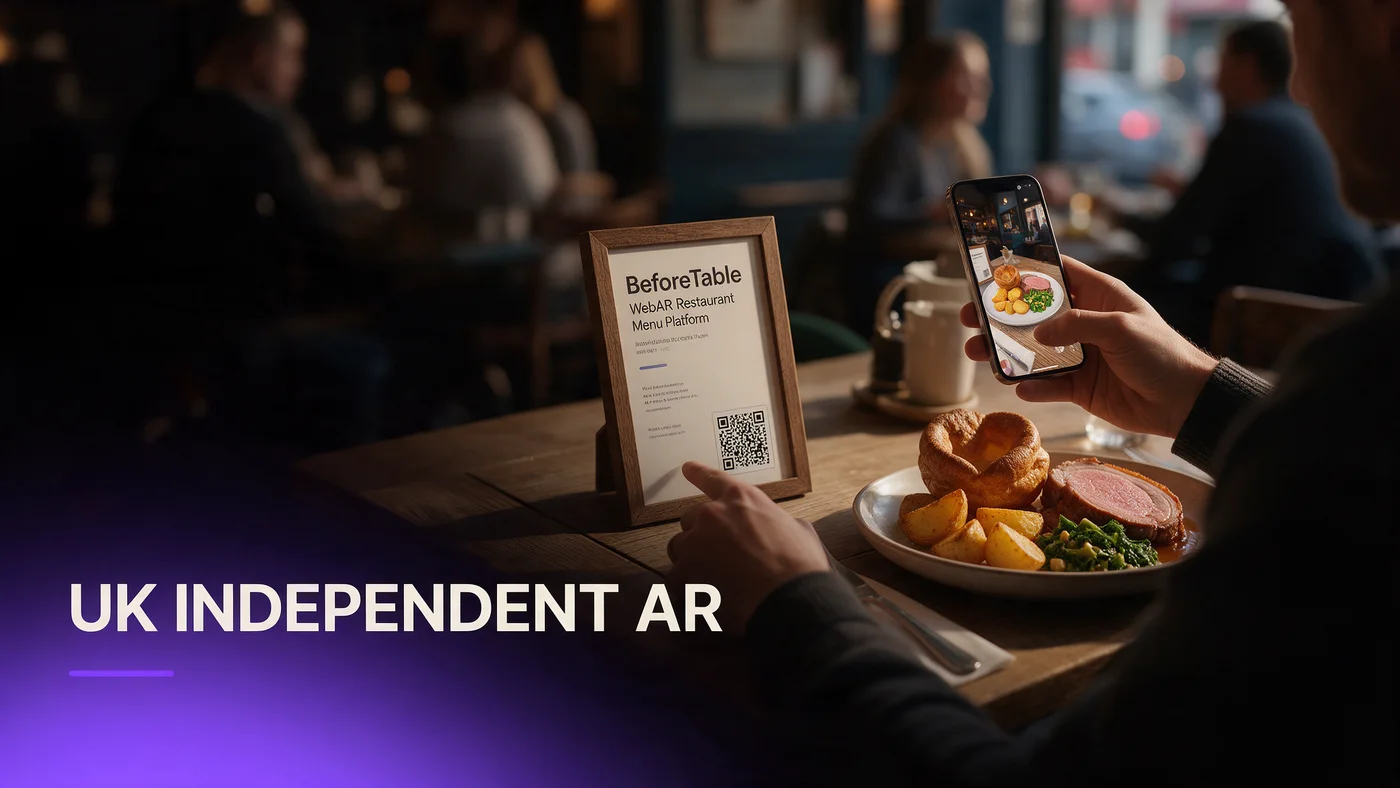
An AR menu for UK independents lets a guest scan a QR code at the table, open the link in their phone's browser, and rotate a real 3D preview of a dish before ordering, with no app to download and no server needed to talk through portion size. For a high-street independent in a market town or a city center side street, that means a guest can see exactly what a Sunday roast or a sharing platter looks like before committing.
WebAR table QR works the same in a twenty-cover bistro as it does in a larger dining room, since the phone's own browser renders the model directly rather than relying on any restaurant hardware.
Why AR beats a printed menu insert here
A printed insert cannot show how tall a Yorkshire pudding actually sits next to the rest of a roast, and laminated inserts wear out fast during a busy weekend service. An AR preview lets a guest rotate a dish and decide with more confidence.
What the guest experience looks like at the table
A guest taps a QR code on a table stand or drinks mat, the dish opens in Safari or Chrome, they rotate it with a finger, then close the tab and keep browsing the rest of the menu.
Why WebAR table QR fits UK high-street independents
The UK has a dense mix of independent restaurants on high streets across market towns and city neighborhoods, many run by an owner covering both the kitchen and the floor. A WebAR menu that needs no app, no special hardware, and no ongoing tech support fits that reality better than a heavier system built for a chain with a head office behind it.
Low-friction tech for owner-operated restaurants
An owner running a bistro on a high street in a smaller town does not have time to manage a complicated backend. Uploading a few photos per dish and printing one QR code is close to the entire technical lift.
Standing out next to chains on the same high street
A small independent sitting near a chain with a bigger marketing budget can offer the same scan-to-preview experience at a fraction of the cost, which levels the playing field on the one thing guests actually notice first.
Showcasing a Sunday roast and other British classics in 3D
A Sunday roast with a Yorkshire pudding, roast potatoes, and all the trimmings benefits enormously from a 3D preview, since the whole appeal is in how generously the plate is arranged rather than any single ingredient.
Hero dishes that benefit most from rotation
A full roast dinner, a tall dessert, or a sharing board benefits more from rotation than a simple soup, so start with dishes where seeing the arrangement genuinely changes a guest's decision.
Regional classics worth featuring first
A fish and chips plate, a pie with a tall crust, or a full roast are strong first candidates across most of the UK, since each has a shape and scale that a flat photo tends to flatten out.
Manchester, Birmingham, Edinburgh, and Bristol: how guests scan
Scanning habits shift slightly by city. Manchester's busy weekend dining crowd scans quickly between a match and dinner plans. Birmingham's diverse food scene sees guests using AR to understand an unfamiliar cuisine before ordering. Edinburgh's tourist-heavy Old Town restaurants see visitors leaning on a preview more than locals do. Bristol's independent-minded crowd tends to linger and rotate a dish out of genuine curiosity.
High-street footfall and quick weekday lunch scanning
A high-street lunch crowd moves fast, often deciding within a minute or two before heading back to work, while an evening booking allows far more time to browse.
Keeping weekday lunch previews fast
Near an office-heavy high street, keep hero dishes to the fastest-loading, simplest models, since a lunch break leaves little patience for a slow load.
Letting evening guests linger over the full menu
In the evening, when a table books ahead and settles in for a longer meal, a longer look at an AR preview is normal and even expected while deciding what to order.
British weather and durable QR table setups
A laminated table insert left out through a wet British autumn softens and curls within weeks. A QR code printed once and lightly laminated survives the weather far better, since the code itself rarely changes even when the dishes behind it do.
Indoor table tents for most of the year
For most of the year, a small table tent or a card on a drinks mat works fine and takes almost no table space during a busy Friday or Saturday service.
Outdoor seating during the short warm stretch
During the brief window when outdoor seating fills up, a weatherproof QR sticker handles a sudden shower better than a paper insert, which curls at the first sign of rain.
GBP guest pricing, VAT awareness, and USD billing clarity
Your restaurant sets menu prices in pounds sterling for guests, including however you choose to reflect VAT in your displayed prices, and none of that changes because of AR. This is general information, not tax advice, so confirm your own VAT treatment with your accountant. BeforeTable's own plans are billed in USD, since the platform serves restaurants across multiple countries, so a UK owner should expect their monthly software bill in US dollars even though the menu itself displays GBP prices to guests.
What guests see versus what you pay
A guest scanning a QR code at your table sees GBP prices on every dish exactly as you enter them, VAT-inclusive or not, based on how you already price your menu. The USD billing only affects your monthly subscription invoice.
Budgeting for exchange rate movement
Because the plan cost is fixed in USD, a UK owner's actual cost in GBP can shift slightly with the exchange rate. Starter at $20 a month is small enough that this rarely matters, but it is worth knowing upfront.
Choosing your first three hero dishes
Start small. Three hero dishes in AR is enough to prove the idea works before committing more time to photographing the whole menu.
Picking dishes that define your restaurant
A signature roast, a standout dessert, or a dish guests already ask about by name are strong first choices, since they are the ones most likely to benefit from a confident preview.
A simple one-table test before a full rollout
Print one QR table stand, put it on a single table for a week, and watch how many guests scan it during a normal service before deciding whether to expand across the room.
Testing your AR menu before service starts
Test the guest link on an iPhone in Safari and an Android phone in Chrome before printing a QR code for the floor. Confirm the model loads within a couple of seconds on your restaurant's actual Wi-Fi, since a slow load during a busy Saturday service undoes the good impression AR is supposed to create.
Common mistakes UK independents make with AR menus
The most common mistake is loading ten or more dishes into AR right away instead of proving the concept with three hero dishes first. A second mistake is placing the QR code somewhere a busy table never notices, instead of a dedicated stand at eye level.
What this costs for a UK independent restaurant
Free starts at $0 for 3 AR dishes, enough to test the one-table approach above. Starter is $20 a month for 15 dishes, which covers most independent menus across the UK. Growth is $200 a month for 50 dishes with analytics, useful once you compare performance across a larger menu or multiple locations. See the full breakdown at beforetable.com/blog/beforetable-pricing-explained.
Start free with your first AR menu today
An AR menu for a UK independent restaurant does not require rebuilding your till system or hiring a developer. Photograph three hero dishes, print one QR table stand, and test it during a normal service before deciding how far to take it.
Start Free with 3 AR dishes at $0 and see how guests respond before committing to a paid plan. The FAQ below and beforetable.com/blog/how-to-create-an-ar-restaurant-menu cover setup details.
Frequently Asked Questions
What is an AR menu for UK independent restaurants?
It is a WebAR menu a guest opens by scanning a table QR code, showing a real 3D preview of a dish in their phone's browser with no app required.
Do guests need to download an app to see the AR menu?
No. The preview opens directly in Safari on iPhone or Chrome on Android, with nothing to install.
How much does an AR menu cost for a UK restaurant?
Free is $0 for 3 AR dishes, Starter is $20 a month for 15 dishes, and Growth is $200 a month for 50 dishes with analytics.
Are BeforeTable plans billed in GBP or USD?
Plans are billed in USD since the platform serves restaurants across multiple countries, even though your menu prices to guests stay in GBP.
Do guests see prices in GBP?
Yes. You set every dish price in pounds sterling exactly as you would on a printed menu, and that is what guests see when they scan.
Does the AR menu account for VAT on my prices?
The menu simply displays whatever GBP price you enter, VAT-inclusive or not, based on how you already price your menu. This is general information, not tax advice, so confirm VAT treatment with your accountant.
What devices does the AR menu work on?
It works on iPhone in Safari and Android in Chrome, covering the large majority of guest phones across the UK.
Does the AR menu hold up during typical British weather?
Yes. A laminated indoor table tent works fine most of the year, and a weatherproof QR sticker handles outdoor seating during a sudden shower.
How many dishes should I start with?
Start with three hero dishes that define your restaurant, then expand once you see how guests respond to the AR preview.
Does this work for independents outside Manchester, Birmingham, Edinburgh, and Bristol?
Yes. WebAR works the same way in a smaller market town as it does in a major city, since it only depends on the guest's phone browser.
How long does it take to set up an AR menu?
Uploading photos and creating a 3D preview for one dish takes a short amount of time per dish, so three hero dishes can be ready quickly.
Does BeforeTable replace my POS or till system?
No. BeforeTable is a WebAR menu and light order tool, not a replacement for a POS or till system.
Can I test the AR menu on one table before rolling it out?
Yes, and it is the recommended approach. Print one QR table stand, test it for a week, then decide whether to expand.
What is the difference between Free, Starter, and Growth plans?
Free covers 3 dishes at $0, Starter covers 15 dishes at $20 a month, and Growth covers 50 dishes at $200 a month with analytics.
Does Growth plan analytics help compare performance across UK locations?
Yes. Growth's analytics dashboard shows guest interaction with the AR preview, which is useful when comparing performance across cities or sites.
Can tourists in a city like Edinburgh use the AR menu easily?
Yes. A visitor unfamiliar with a dish can rotate a 3D preview to see exactly what it looks like before ordering, with no app or language barrier involved.
Where can I find more on pricing and setup?
See beforetable.com/blog/beforetable-pricing-explained for pricing details and beforetable.com/blog/how-to-create-an-ar-restaurant-menu for setup steps.