Geo · Vancouver, Canada
AR Menu Vancouver Restaurants: WebAR Table QR for Pacific Northwest Dining (2026)
How Vancouver independent restaurants use WebAR table QR menus to show 3D dish previews across Gastown and Kitsilano, no guest app, plans from $20 a month.
2026-09-09 · 9 min read · BeforeTable
What an AR menu means for Vancouver independent restaurants
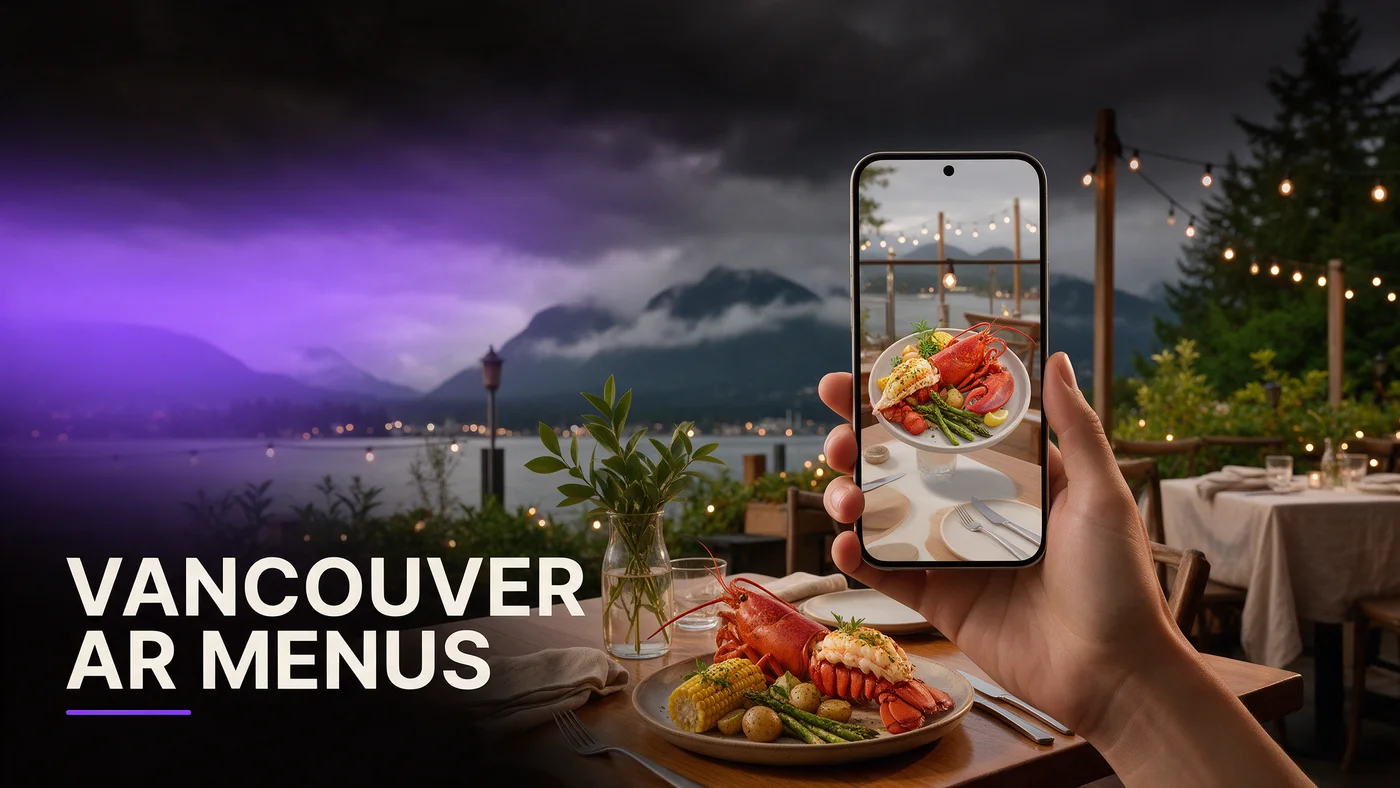
An AR menu for Vancouver restaurants lets a guest scan a QR code at the table and rotate a real 3D preview of a dish in Safari or Chrome, with no app to download. For an independent in Gastown, Kitsilano, or along Commercial Drive, that means a guest sees exactly what a dish looks like before committing.
WebAR menus work the same way across the city. The phone's own browser renders the model directly, so a guest on a Yaletown patio sees the same crisp preview as a guest at a counter in Chinatown.
Why a 3D preview beats a flat menu photo
A flat photo cannot show how large a shareable platter really is, and a laminated menu wears out fast during a wet Vancouver winter. A rotating AR preview lets a guest judge portion size before they order.
What guests actually do at the table
There is no app store visit and no account to create. A guest taps a QR code, rotates the dish with a finger swipe, then closes it and keeps reading the rest of the menu.
Why WebAR fits Vancouver's tech-forward, mixed-device dining scene
Vancouver's dining rooms mix iPhones and Android phones about evenly, and a large share of guests are visiting from elsewhere in Canada, the US, or overseas. A WebAR menu that works in Safari and Chrome without an install step removes any question about which app store a guest needs.
No app download needed on guest LTE or transit Wi-Fi
SkyTrain platforms and older buildings near Gastown do not always offer strong Wi-Fi. A WebAR link loads a much lighter page, so it still works when the connection is not perfect.
Cross-border and visiting guests already expect this
American visitors and guests arriving from Asia or Europe increasingly expect a scan-to-preview experience from any city they eat in, so offering it puts a small independent on equal footing with a larger, better-funded restaurant nearby.
Gastown, Kitsilano, Commercial Drive, and Yaletown: how neighborhoods differ
Guest behavior is not the same across Vancouver's neighborhoods. Gastown sees more tourists, Kitsilano leans daytime and health-focused, and Commercial Drive with Yaletown draw local regulars who already know what they want.
Gastown's tourist and late dinner crowd
Tourists exploring Gastown's cobblestone blocks often try a cuisine for the first time, so an AR preview helps them understand an unfamiliar dish before committing to a full dinner order.
Kitsilano's health-conscious daytime guests
Kitsilano guests frequently ask about ingredients and portion size before lunch, so a rotating preview that shows the actual plate size answers a question a server would otherwise repeat all day.
Commercial Drive and Yaletown's local regulars
Regulars on Commercial Drive or in Yaletown already know the menu, so AR works best there for new seasonal dishes or specials they have not tried yet, rather than for every item.
Showing seafood and Asian fusion dishes guests may not recognize
Vancouver's restaurant scene leans heavily on seafood and Asian fusion cooking, both of which benefit from a preview that a flat photo struggles to capture.
Why seafood benefits from a rotating 3D preview
A whole fish or a large platter is hard to judge from a single photo angle. Rotating the model lets a guest see the actual scale before deciding whether to share it.
Asian fusion plating that a photo alone cannot explain
A layered bowl with hidden components underneath benefits from a 3D view that shows depth, helping a first-time guest understand what they are ordering.
Rainy season menus: why indoor QR wins most of the year
Vancouver's reputation for rain is well earned, and most dining from fall through early spring happens indoors, where a laminated paper insert absorbs moisture and curls within weeks.
Table tents and check presenters through the wet months
A small table tent or a check presenter sticker works well from October through April, when almost all covers are indoors and the QR code rarely faces outdoor weather.
Keeping a laminated code dry enough to scan
If a table tent sits near a door, use a fully sealed matte laminate so condensation and drips do not blur the code during a busy, wet evening service.
Vancouver's short patio season and outdoor QR durability
Vancouver's patio season is shorter than many Canadian cities, typically running from late May through early September. A weatherproof QR sticker or a small stand-up card handles that short outdoor window better than a laminated insert, which starts curling after a few damp evenings.
CAD guest pricing and USD billing, explained clearly
Your restaurant sets menu prices in Canadian dollars for guests, and that never changes because of AR. BeforeTable's own plans are billed in USD, since the platform serves restaurants across North America, so a Vancouver owner should expect their monthly software bill in US dollars even though the menu itself displays CAD prices to guests.
What guests see versus what you pay
A guest scanning a QR code in Gastown sees CAD prices exactly as you enter them. The USD billing only affects your monthly invoice.
Budgeting for exchange rate movement
Because the plan cost is fixed in USD, a Vancouver owner's actual cost in CAD can shift slightly with the exchange rate, though Starter at $20 a month is small enough that this rarely matters.
Choosing your first three hero dishes
Start small. Three hero dishes in AR is enough to prove the idea works before committing more time to photographing an entire seafood-heavy or fusion-heavy menu.
Picking dishes that benefit most from rotation
A seafood tower or a shareable fusion platter benefits more from a 3D view than a simple bowl of soup, so start with dishes where size actually changes a guest's decision.
A one-table test before a full rollout
Print one QR table tent, place it on a single table for a week, and watch how many guests scan it before deciding whether to expand across the room.
Testing your AR menu before service starts
Test the guest link on an iPhone in Safari and an Android phone in Chrome before printing a QR code for the floor. Confirm the model loads within a couple of seconds on your actual Wi-Fi or nearby LTE, since a slow load during a rainy Friday rush undoes the impression AR is supposed to create.
Common mistakes Vancouver independents make with AR menus
The most common mistake is treating AR as a replacement for the whole menu instead of a highlight for a few hero dishes, which overwhelms the kitchen and the guest. A second mistake is leaving a paper table tent out during the rainy months without checking it, since a curled code stops scanning before staff notice.
What this costs for a Vancouver independent restaurant
Free starts at $0 for 3 AR dishes, enough to test the one-table approach above. Starter is $20 a month for 15 dishes, which covers most independent menus in Gastown or Kitsilano. Growth is $200 a month for 50 dishes with analytics, useful once you compare performance across a larger menu. See the full breakdown at beforetable.com/pricing.
Start free with your first Vancouver AR menu today
An AR menu for a Vancouver restaurant does not require rebuilding your menu system or hiring a developer. Photograph three hero dishes, print one QR table tent, and test it during a normal service before deciding how far to take it.
Start Free with 3 AR dishes at $0 and see how guests respond. The FAQ below and beforetable.com/faq cover more setup details, and beforetable.com/blog/restaurant-ar-menu-canada looks at the same approach across the rest of Canada.
Frequently Asked Questions
What is an AR menu for Vancouver restaurants?
It is a WebAR menu a guest opens by scanning a table QR code, showing a real 3D preview of a dish in their phone's browser with no app required.
Do guests need to download an app to see the AR menu?
No. The preview opens directly in Safari on iPhone or Chrome on Android, with nothing to install and no account to create.
Does an AR menu work well for seafood dishes?
Yes. A whole fish, a seafood tower, or a large shared platter benefits from a rotating preview that shows true scale better than a single photo angle.
Can AR help explain Asian fusion dishes to first-time guests?
Yes. A layered bowl or a dish with hidden components benefits from a 3D view that shows structure a flat photo cannot capture.
How much does an AR menu cost for a Vancouver restaurant?
Free is $0 for 3 AR dishes, Starter is $20 a month for 15 dishes, and Growth is $200 a month for 50 dishes with analytics.
Are BeforeTable plans billed in CAD or USD?
Plans are billed in USD since the platform serves restaurants across North America, even though your menu prices to guests stay in CAD.
Do guests see menu prices in CAD?
Yes. You set every dish price in Canadian dollars exactly as on a printed menu, and that is what guests see when they scan.
What devices does the AR menu work on?
It works on iPhone in Safari and Android in Chrome, covering the large majority of guest phones in Vancouver.
Does an AR menu work during Vancouver's rainy season?
Yes. A small indoor table tent or a check presenter sticker works fine from fall through spring, when almost all dining moves indoors.
How long is patio season for outdoor QR codes in Vancouver?
Patio season typically runs from late May through early September, so plan on a weatherproof QR sticker for that shorter outdoor window.
How many dishes should I start with?
Start with three hero dishes that define your restaurant, then expand once you see how guests respond to the AR preview.
Does this work for independents outside downtown Vancouver?
Yes. WebAR works the same way in Kitsilano, Commercial Drive, or a suburban location, since it only depends on the guest's phone browser.
How long does it take to set up an AR menu?
Uploading photos and creating a 3D preview for one dish takes a short amount of time, so three hero dishes can be ready quickly.
Does BeforeTable replace my POS system?
No. BeforeTable is a WebAR menu and light order tool, not a replacement for a POS system.
Can I test the AR menu on one table before rolling it out?
Yes, and it is the recommended approach. Print one QR table tent, test it for a week, then decide whether to expand.
What is the difference between Free, Starter, and Growth plans?
Free covers 3 dishes at $0, Starter covers 15 dishes at $20 a month, and Growth covers 50 dishes at $200 a month with analytics.
Where can I find more on pricing and setup?
See beforetable.com/pricing for plan details and beforetable.com/faq for common setup questions.