Geo · Canada
Canada Independent Digital Menu AR: WebAR QR Beyond Big Cities (2026)
How independent restaurants in smaller Canadian cities use WebAR QR menus to show 3D dish previews in English and French, no guest app, plans from $20 a month.
2026-09-17 · 8 min read · BeforeTable
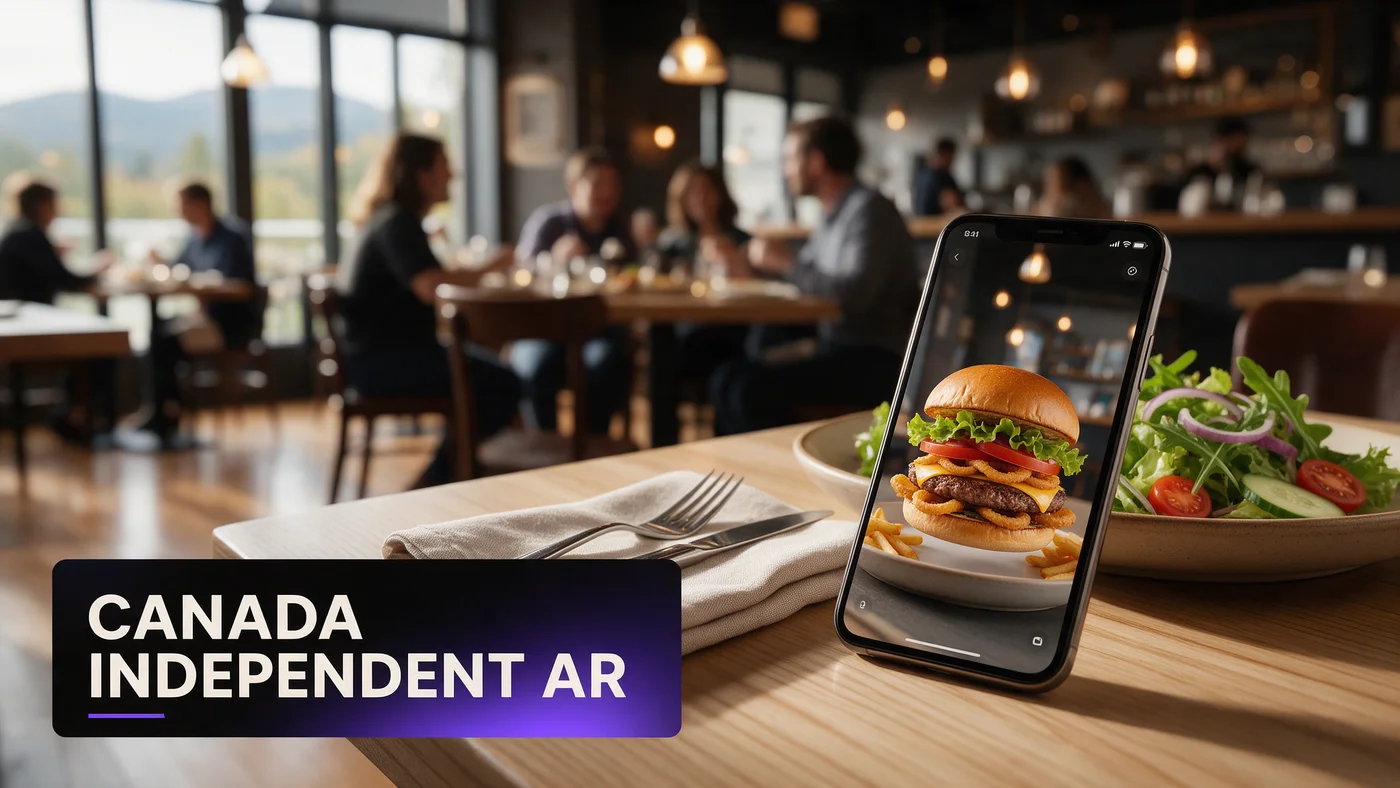
Independent digital menu AR is not just a big-city story
It is easy to assume WebAR menus only make sense in Toronto or Vancouver, where guest volume and marketing budgets are highest. In practice, independent digital menu AR works exactly the same way in Kelowna, Kingston, Moncton, or Regina, since a WebAR menu depends on the guest's own phone browser, not the size of the city.
A guest in a smaller Canadian city scans the same kind of QR code and rotates the same kind of 3D dish preview as a guest in a major downtown core, with no app to download either way.
Why the big-city framing misses most independents
Most independent restaurants in Canada do not operate in Toronto or Vancouver at all. Smaller cities and towns make up a large share of the country's dining rooms.
What actually changes outside the biggest cities
What changes is guest volume and marketing reach, not the technology itself. A WebAR link performs the same whether ten guests scan it in a week or a thousand.
Why WebAR fits smaller Canadian dining rooms so well
An independent restaurant outside a major metro area often runs with a smaller staff and a tighter budget than a downtown competitor, which makes a low-friction system more valuable, not less. A WebAR menu needs no app, no special hardware, and no dedicated tech support.
Low overhead matters more with a smaller team
Uploading a few photos per dish and printing one QR code is close to the entire technical lift, with no ongoing app maintenance or store listing to keep updated.
Competing with chains without a chain budget
A chain location nearby may have more marketing dollars, but a WebAR menu lets an independent offer the same scan-to-preview experience at a fraction of the cost.
English and French menu text outside Quebec and Ottawa
Bilingual menu writing is usually framed around Quebec and Ottawa, but smaller cities across the country have their own pockets of French-speaking guests and cross-provincial travelers who appreciate seeing both languages.
Deciding if French matters for your guest mix
Look at your actual reservation and walk-in patterns rather than assuming French is unnecessary just because you are outside Quebec.
Keeping both languages consistent in tone
Write the English and French description for each dish at the same time, so neither version reads like an afterthought translation.
CAD guest prices, USD software billing
Your restaurant sets every dish price in Canadian dollars for guests, and a WebAR menu does not change that regardless of city size. BeforeTable's own plans are billed in USD, since the platform serves restaurants across North America, so expect your monthly invoice in US dollars even though the menu always shows CAD prices.
What guests see versus what you pay
A guest scanning a QR code sees CAD prices exactly as entered, whether at a small town diner or a big-city bistro. USD billing only affects your own subscription invoice.
Why a fixed USD plan is easier to budget for
Starter at $20 a month is small enough that exchange rate movement rarely changes the decision, and a fixed USD cost is simple to plan for anywhere in Canada.
Winter QR menus outside the biggest metro areas
Winter hits smaller Canadian cities and towns just as hard as Toronto or Calgary, often with less foot traffic to offset the season. A QR code printed once and lightly laminated keeps working through the cold months, unlike a paper table tent that warps and fades.
Indoor QR setups for quieter winter months
A small table tent or a sticker on the check presenter works fine through a slow winter service, taking up little counter space.
Getting ahead of spring patio season
Once patio season returns, switch to a weatherproof QR sticker or a stand-up card, which handles sun and rain better than a paper insert left outside.
Guest habits vary by town, not just by big city
A resort town guest scanning between ski runs behaves differently than a guest at a small-city family restaurant on a Sunday, and both differ from a Toronto lunch crowd. None of this changes how the AR menu works, but it helps to notice your own dining room's rhythm.
Choosing your first three hero dishes
Start small regardless of city size. Three hero dishes in AR is enough to prove the idea works before photographing the whole menu.
Picking dishes that benefit most from rotation
A tall burger, a shareable platter, or a layered dessert benefits more from rotation than a simple bowl of soup.
A simple one-table test before a full rollout
Print one QR table tent, put it on a single table for a week, and watch how many guests scan it before deciding whether to expand.
Testing your AR menu before service starts
Test the guest link on an iPhone in Safari and an Android phone in Chrome before printing a QR code for the floor. Confirm the model loads in a couple of seconds on your restaurant's actual Wi-Fi.
Common mistakes independents make outside major cities
The most common mistake is assuming WebAR only works for a big-city flagship and skipping it entirely, when the technology performs identically at any guest volume. A second mistake is loading ten or more dishes into AR right away instead of starting with three hero dishes.
What this costs for an independent restaurant in Canada
Free starts at $0 for 3 AR dishes, enough to test the one-table approach above regardless of city size. Starter is $20 a month for 15 dishes, which covers most independent menus. Growth is $200 a month for 50 dishes with analytics. See the full breakdown at beforetable.com/blog/beforetable-pricing-explained. For a closer look at Toronto and Vancouver specifics, see beforetable.com/blog/restaurant-ar-menu-canada.
Start free with your first AR dishes today
Independent digital menu AR does not require a downtown location, a big marketing budget, or a developer on staff. Photograph three hero dishes, print one QR table tent, and test it during a normal service before deciding how far to take it.
Start Free with 3 AR dishes at $0 and see how guests respond before committing to a paid plan. The FAQ below and beforetable.com/blog/how-to-create-an-ar-restaurant-menu cover setup details.
Frequently Asked Questions
Does WebAR only work well for restaurants in Toronto or Vancouver?
No. WebAR depends on the guest's phone browser, not the size of the city, so it performs the same way anywhere in Canada.
What is independent digital menu AR?
It is a WebAR menu a guest opens by scanning a QR code, showing a 3D preview of a dish in their phone's browser with no app download.
Do guests need to download an app to see the AR menu?
No. The AR preview opens directly in Safari on iPhone or Chrome on Android, with nothing to install and no account to create.
Do I need a bilingual menu if I am outside Quebec or Ottawa?
Not necessarily, but check your actual guest mix. Smaller cities can still see meaningful French-speaking or cross-provincial guest traffic.
How much does independent digital menu AR cost in Canada?
Free is $0 for 3 AR dishes, Starter is $20 a month for 15 dishes, and Growth is $200 a month for 50 dishes with analytics.
Are BeforeTable plans billed in CAD or USD?
Plans are billed in USD since the platform serves restaurants across North America, even though guest prices stay in CAD.
Do guests see prices in CAD?
Yes. You set every dish price in Canadian dollars exactly as on a printed menu, and that is what guests see when they scan.
What devices does the AR menu work on?
It works on iPhone in Safari and Android in Chrome, covering the large majority of guest phones across Canada, including smaller cities.
Does this work for a restaurant in a small town or resort area?
Yes. The AR preview works the same regardless of guest volume, so a small-town or resort-town restaurant gets the same experience as a downtown location.
Does an AR menu work during a Canadian winter outside the big cities?
Yes. A small indoor table tent or a sticker on the check presenter works fine for the colder months, even with lighter foot traffic.
What about patio season in a smaller city?
Use a weatherproof QR sticker or a stand-up card outdoors, since a paper insert curls and fades after a few weeks in the sun.
How many dishes should I start with?
Start with three hero dishes that define your restaurant, then expand once you see how guests respond.
How is this different from a general Canada AR menu guide?
This guide focuses specifically on independents outside Toronto and Vancouver. For city-specific detail on those two markets, see beforetable.com/blog/restaurant-ar-menu-canada.
How long does it take to set up an AR menu?
Uploading photos and creating a 3D preview for one dish takes a short amount of time, so three hero dishes can be ready quickly.
Does BeforeTable replace my POS system?
No. BeforeTable is a WebAR menu and light order tool, not a replacement for a POS system.
Can I test the AR menu on one table before rolling it out?
Yes, and it is the recommended approach. Print one QR table tent, test it for a week, then decide whether to expand.
What is the difference between Free, Starter, and Growth plans?
Free covers 3 dishes at $0, Starter covers 15 dishes at $20 a month, and Growth covers 50 dishes at $200 a month with analytics.
Do I need a bigger marketing budget to make this work outside a major city?
No. A WebAR menu works the same at any guest volume, so a smaller-city independent gets the identical technical experience without a big-city marketing spend.
Where can I find more on pricing and setup?
See beforetable.com/blog/beforetable-pricing-explained for pricing details and beforetable.com/blog/how-to-create-an-ar-restaurant-menu for setup steps.