Geo · Canada
Restaurant AR Menu Canada: WebAR QR Menus for Canadian Independents (2026)
How independent restaurants across Canada use WebAR QR menus to show 3D dish previews in English and French, no guest app, plans from $20 a month.
2026-09-08 · 9 min read · BeforeTable
What a restaurant AR menu means for independents across Canada
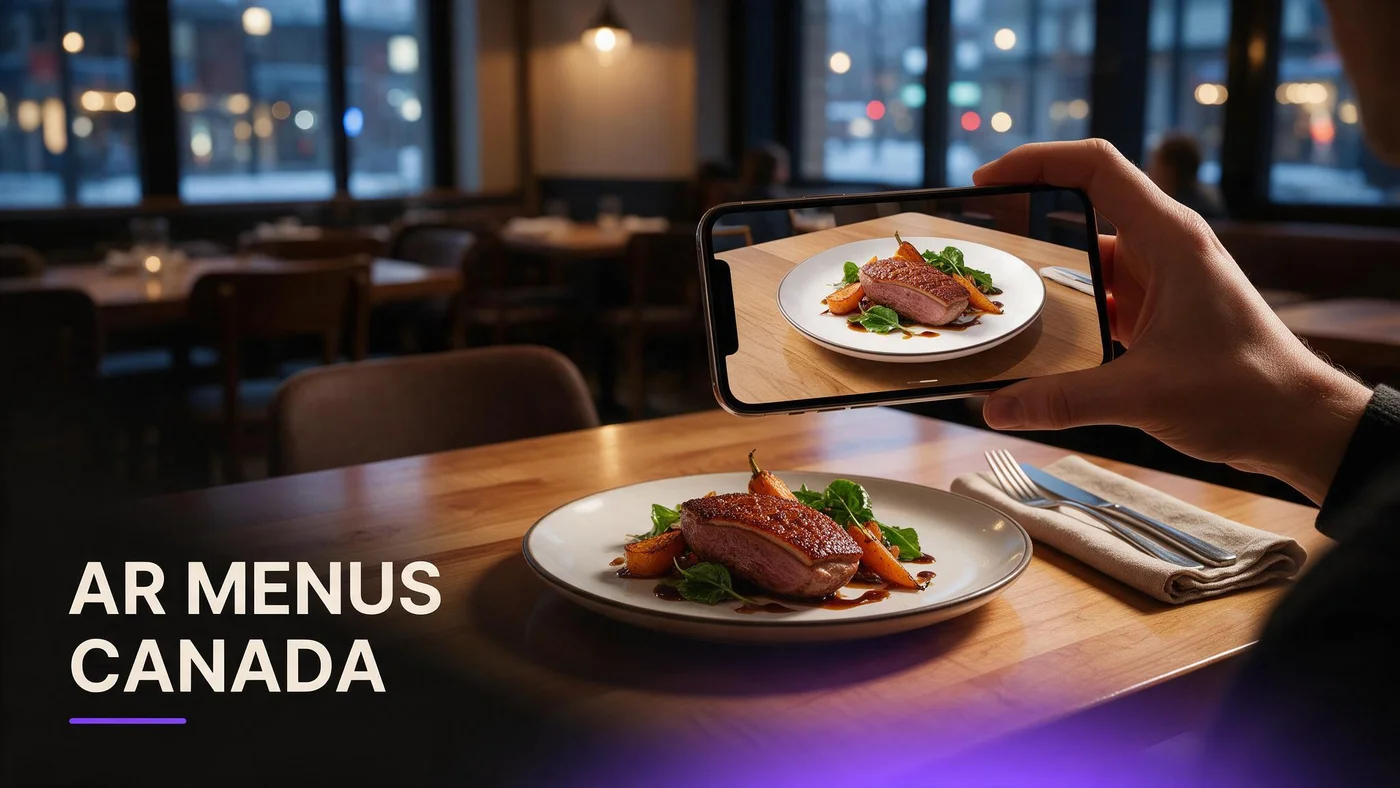
A restaurant AR menu in Canada lets a guest scan a QR code at the table, open a link in Safari or Chrome, and watch a real 3D preview of a dish rotate on their own phone, with no app download and no server needed to describe portion size. For an independent in Toronto, Vancouver, Calgary, or a smaller town, that means showing exactly what a poutine, a bao bun, or a seafood platter looks like before a guest commits, in whichever language they read comfortably.
WebAR menus work the same way coast to coast. The phone's own browser renders the model directly, so a guest on a patio in Kelowna sees the same crisp preview as a guest at a downtown Toronto counter.
Why AR beats a photo or a paper menu here
A flat photo cannot show portion size or how a sauce sits on a plate, and paper menus wear out fast during a Canadian winter when boots track in slush. An AR preview lets a guest rotate a dish and decide with more confidence.
What guests actually see on their phone
There is no app store visit and no login. A guest taps a QR code, the dish opens in the browser, and they rotate the model with a finger swipe, then close it and keep browsing the menu.
Why WebAR fits Canada's mixed device and language reality
Canadian dining rooms mix iPhones and Android phones roughly evenly, plus a meaningful share of guests switching between English and French depending on the city and the table. A WebAR menu that works in Safari and Chrome without an install step removes the friction of asking which app store a guest needs, since there is none.
No app means no download friction on shared restaurant Wi-Fi
Restaurant Wi-Fi in older buildings, especially in Montreal's historic blocks or a Prairie town's main street, is not always fast enough for a large app download. A WebAR link loads a much lighter page instead.
Cross-border guests expect this by now
American visitors and Canadian guests who travel increasingly expect a scan-to-preview experience, so offering it puts an independent on equal footing with bigger chains without a chain-level budget.
Building a bilingual AR menu guests actually trust
Language matters more in Canada than in most markets, especially in Quebec, parts of Ontario, and federally regulated spaces. A dish description that only exists in English can quietly turn away a guest who would rather read the menu in French, even if their English is fine.
Where bilingual matters most
Montreal and Ottawa restaurants often need both languages by expectation, while a Vancouver or Calgary independent may only need English plus perhaps Mandarin or Punjabi. Decide based on your actual guest mix, not a generic assumption.
Keeping dish names and descriptions consistent
Write the English and French description for a dish at the same time, so the French version matches the tone of the English one instead of reading like an afterthought translation.
AR menus through Canadian winters and patio season
A laminated table tent left out all winter warps and fades, needing replacing every season. A QR code printed once and lightly laminated survives a Canadian winter far better, since the code itself rarely changes even when the dishes behind it do.
Indoor QR tents during the cold months
From November through March, most Canadian dining happens indoors, so a small table tent or a sticker on the check presenter works fine and takes almost no counter space during a busy service.
Patio season and outdoor QR durability
Once patio season opens in May or June, a weatherproof QR sticker on the table or a small stand-up card handles sun and the occasional rain shower better than a laminated paper insert, which curls at the edges after a few weeks outside.
Guest habits across Toronto, Vancouver, and Calgary
Guest habits differ slightly by city. Toronto's downtown sees quick subway and streetcar scanning between stops, Vancouver's guests lean toward evening patio scanning near the water, and Calgary's office lunch crowd scans fast during short breaks. None of this changes how the AR menu works, but it helps to know your own city's rhythm.
CAD guest pricing and USD billing, explained clearly
Your restaurant sets menu prices in Canadian dollars for guests, and that never changes because of AR. BeforeTable's own plans are billed in USD, since the platform serves restaurants across North America, so a Canadian owner should expect their monthly software bill in US dollars even though the menu itself displays CAD prices to guests.
What guests see versus what you pay
A guest scanning a QR code in Toronto sees CAD prices on every dish exactly as you enter them. The USD billing only affects your monthly subscription invoice, not anything the guest interacts with.
Budgeting for exchange rate movement
Because the plan cost is fixed in USD, a Canadian owner's actual cost in CAD can shift slightly with the exchange rate. Starter at $20 a month is small enough that this rarely matters, but it is worth knowing upfront.
Choosing your first three hero dishes
Start small. Three hero dishes in AR is enough to prove the idea works before committing more time to photographing the whole menu.
Picking dishes that benefit most from a 3D preview
A tall burger, a shareable platter, or a layered dessert benefits more from rotation than a simple bowl of soup, so start with dishes where seeing the shape and size actually changes a decision.
A simple one-table test before a full rollout
Print one QR table tent, put it on a single table for a week, and watch how many guests scan it during a normal service before deciding whether to expand across the room.
Testing your AR menu before service starts
Test the guest link on an iPhone in Safari and on an Android phone in Chrome before printing a QR code for the floor. Confirm the model loads in a couple of seconds on your restaurant's actual Wi-Fi, since a slow load during a busy rush undoes the good impression AR is supposed to create.
Common mistakes Canadian independents make with AR menus
The most common mistake is skipping the French translation in a market where guests expect it, which reads as an oversight rather than a deliberate choice. A second mistake is loading ten or more dishes into AR right away instead of proving the concept with three hero dishes first.
What this costs for a Canadian independent restaurant
Free starts at $0 for 3 AR dishes, enough to test the one-table approach above. Starter is $20 a month for 15 dishes, which covers most independent menus. Growth is $200 a month for 50 dishes with analytics, useful once you compare performance across a larger menu or multiple locations. See the full breakdown at beforetable.com/blog/beforetable-pricing-explained.
Start free with your first AR dishes today
A restaurant AR menu in Canada does not require rebuilding your menu system or hiring a developer. Photograph three hero dishes, print one QR table tent, and test it during a normal service before deciding how far to take it.
Start Free with 3 AR dishes at $0 and see how guests respond before committing to a paid plan. The FAQ below and beforetable.com/blog/how-to-create-an-ar-restaurant-menu cover setup details.
Frequently Asked Questions
What is a restaurant AR menu in Canada?
It is a WebAR menu a guest opens by scanning a QR code at the table, showing a real 3D preview of a dish in their phone's browser with no app download.
Do guests need to download an app to see the AR menu?
No. The AR preview opens directly in Safari on iPhone or Chrome on Android, with nothing to install and no account to create.
Does BeforeTable work in both English and French?
Yes. You can write dish names and descriptions in both languages, which matters most in Quebec, Ottawa, and other bilingual markets.
How much does a restaurant AR menu cost in Canada?
Free is $0 for 3 AR dishes, Starter is $20 a month for 15 dishes, and Growth is $200 a month for 50 dishes with analytics.
Are BeforeTable plans billed in CAD or USD?
Plans are billed in USD since the platform serves restaurants across North America, even though your menu prices to guests stay in CAD.
Do guests see prices in CAD?
Yes. You set every dish price in Canadian dollars exactly as you would on a printed menu, and that is what guests see when they scan.
What devices does the AR menu work on?
It works on iPhone in Safari and Android in Chrome, which covers the large majority of guest phones across Canada.
Does an AR menu work during a Canadian winter?
Yes. A small indoor table tent or a sticker on the check presenter works fine for the colder months when most dining moves indoors.
What about patio season?
Use a weatherproof QR sticker or a stand-up card outdoors, since a laminated paper insert curls and fades after a few weeks in the sun.
How many dishes should I start with?
Start with three hero dishes that define your restaurant, then expand once you see how guests respond to the AR preview.
Does this work for independent restaurants outside Toronto and Vancouver?
Yes. WebAR works the same way in a smaller town as it does in a major city, since it only depends on the guest's phone browser.
Do I need bilingual menus everywhere in Canada?
Not everywhere. It matters most in Quebec, Ottawa, and other markets with a large French-speaking guest base, so decide based on your own guest mix.
How long does it take to set up an AR menu?
Uploading photos and creating a 3D preview for one dish takes a short amount of time per dish, so three hero dishes can be ready quickly.
Does BeforeTable replace my POS system?
No. BeforeTable is a WebAR menu and light order tool, not a replacement for a POS system.
Can I test the AR menu on one table before rolling it out?
Yes, and it is the recommended approach. Print one QR table tent, test it for a week, then decide whether to expand.
What is the difference between Free, Starter, and Growth plans?
Free covers 3 dishes at $0, Starter covers 15 dishes at $20 a month, and Growth covers 50 dishes at $200 a month with analytics.
Does Growth plan analytics help compare locations across Canada?
Yes. Growth's analytics dashboard shows guest interaction with the AR preview, which is useful when comparing performance across cities or locations.
Where can I find more on pricing and setup?
See beforetable.com/blog/beforetable-pricing-explained for pricing details and beforetable.com/blog/how-to-create-an-ar-restaurant-menu for setup steps.